
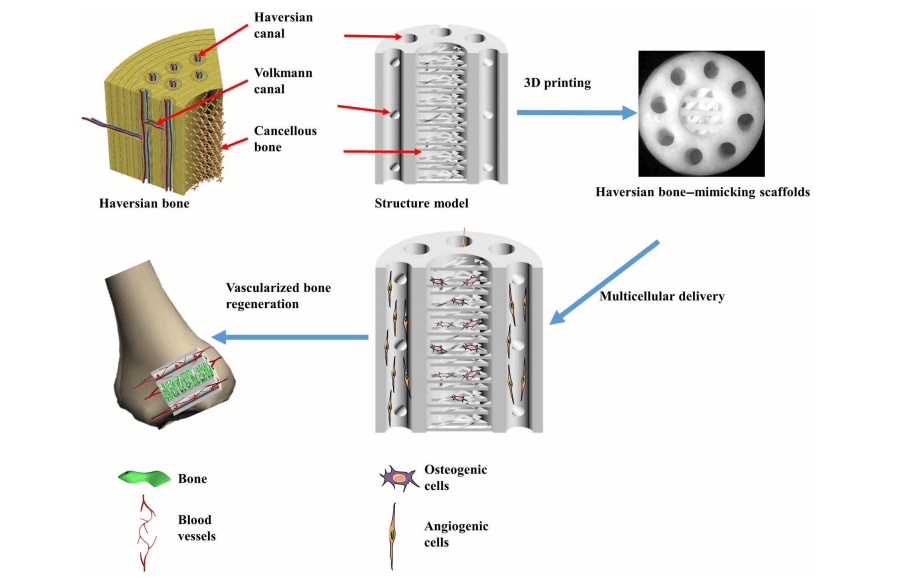
Chinese researchers continue to take on the challenge of bone regeneration in tissue engineering, sharing their findings in the recently released ‘ 3D printing of Haversian bone—mimicking scaffolds for multicellular delivery in bone regeneration .’
.
The fabrication of scaffolds is at the center of successful bone regeneration, but this is an area of medicine that is still known to be difficult—despite a wide range of research projects performed already, from using variations in nanotubes to structures with controlled antibiotic release , alternative materials and coatings.
.
As the authors point out, while bioprinting is an area of medical research where scientists have made huge strides, there are several reasons that obstacles remain: .
Complexity of hierarchical structures
Mechanical property requirements
Diversity of bone resident cells .
Most regeneration occurs in cancellous bone, however, so this is what researchers must focus on for success in treating patients: “Cancellous bone is a meshwork […]
Click here to view original web page at 3dprint.com



0 Comments