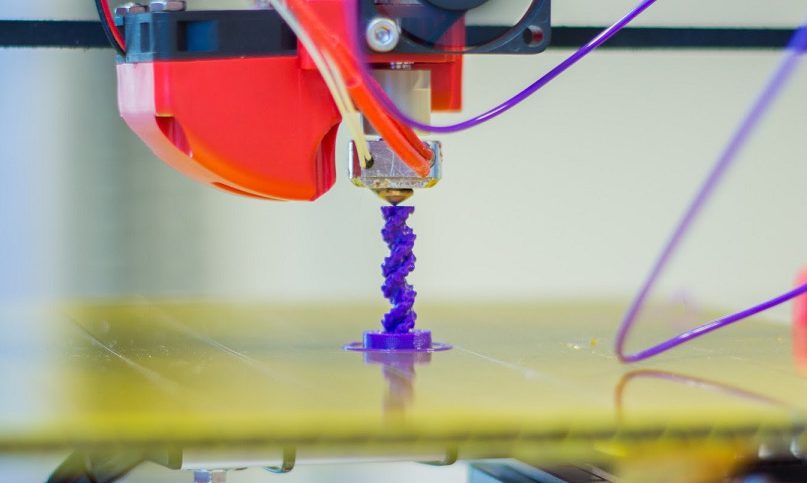
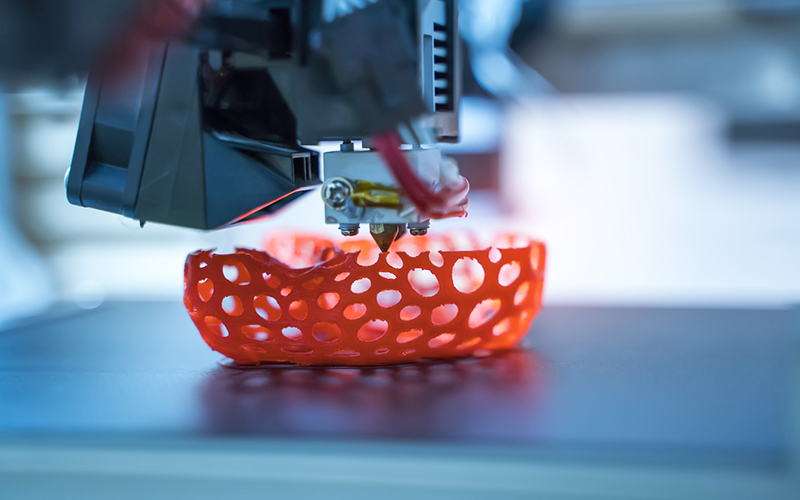
Critical care at the battlefield will save lives and provide a more complete recovery thanks to the innovative use of 3D printers. 3D printers can be deployed in desert and remote environments to fabricate medical tools and biomaterials, where it’s not practical to have soldiers carry hundreds of medical supplies in their packs.
.
This was demonstrated by a pilot program conducted by the Uniformed Services University (USU) of the Health Sciences. The pilot program, called Fabrication in Austere Environments, is designed to fabricate medical products and tissues in harsh environments with a ruggedized 3D printer. The project is part of USU’s federally-funded 4-Dimensional Bioprinting, Biofabrication, and Biomanufactuing (4D Bio3) Program, along with the U.S. Military Academy at West Point, the Geneva Foundation as well as two manufacturers — 3D printer maker NScryp. and commercial space company Techshot. Announced in 2018, the five-year program is tasked with researching, developing, and applying new bioprinting, biofabrication, and biomanufacturing technologies. The first 3D printer deployed and tested in harsh environments was nScrypt’s heavier and larger ruggedized 3D bioprinter, called nRugged, which was developed for the U.S. Army. Made out of a carbon fiber material it is mostly […]
Click here to view original web page at i-hls.com

0 Comments